About HOME
Summary
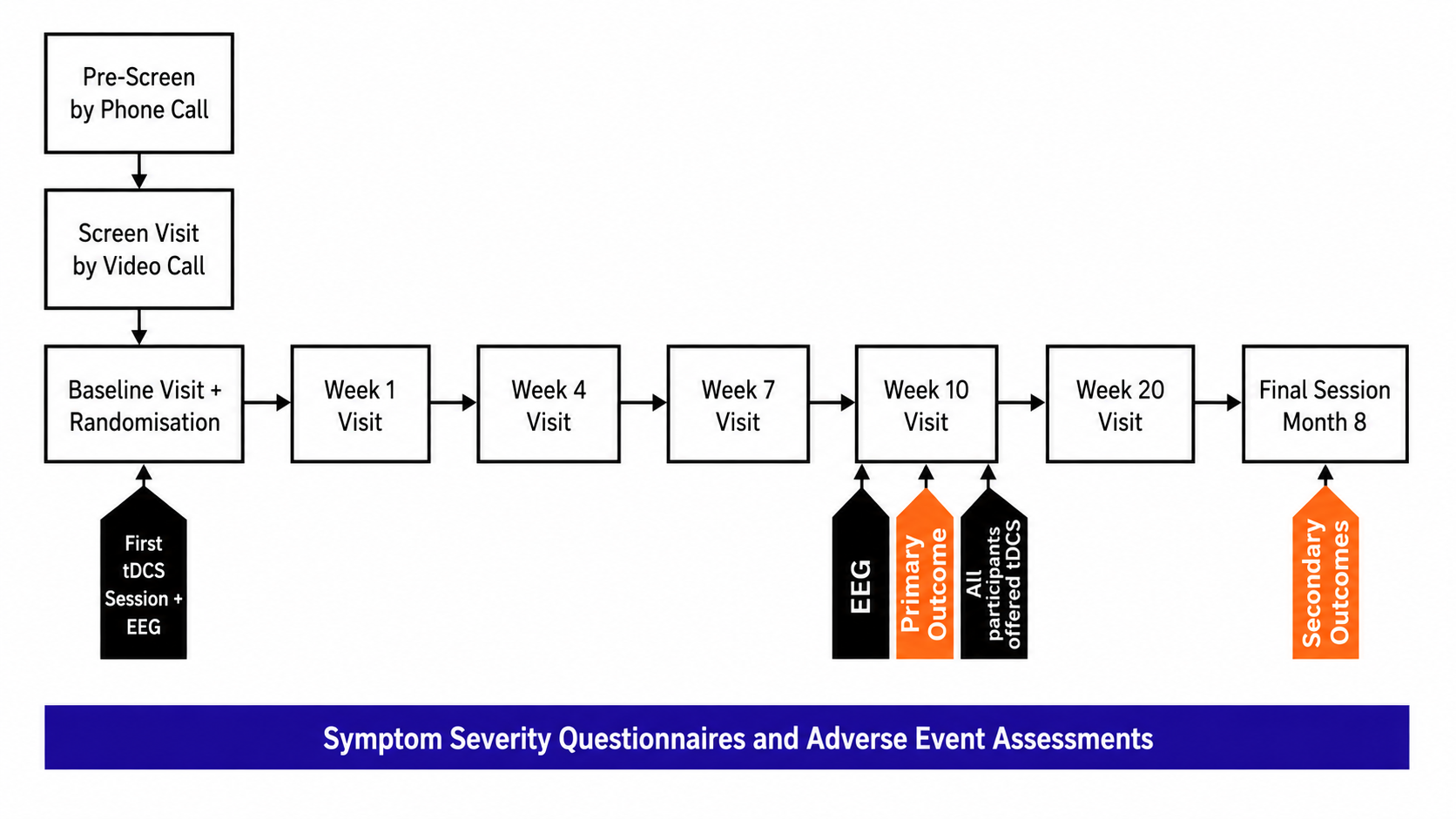
ADEP is a single-site, double-blind, randomised, sham-controlled clinical trial investigating the acceptability, feasibility, safety, clinical outcomes, and neurophysiological correlates of home-based transcranial direct current stimulation (tDCS) for adolescent depression. The study plans to recruit 50 young people aged 15–19 years with a diagnosis of depression.
Participants will be randomly allocated to receive either active or sham tDCS for 10 weeks. Treatment consists of 36 home-based sessions: five sessions per week for the first three weeks, followed by three sessions per week for the following seven weeks. Each session lasts 30 minutes.
The primary outcome is treatment acceptability at Week 10. Secondary outcomes include feasibility, safety, changes in depressive and anxiety symptoms, treatment response and remission, and quality of life. Resting-state EEG is recorded at baseline and Week 10 to investigate neurophysiological correlates and potential predictors of treatment response.
The study is sponsored by the University of East London (UEL) and funded by Rosetrees Trust.
The study has received a favourable ethical opinion from the Yorkshire & The Humber – Sheffield Research Ethics Committee and HRA/HCRW Approval (IRAS ID: 352569).
Trial Information
REC Reference: 25/YH/0198
IRAS: 352569
ISRCTN:
Sponsor: University of East London
Funder: Rosetrees Trust
Enrolment: 50
Study Population
Inclusion Criteria
Aged 15–19 years
Diagnosis of major depressive disorder made by a GP or psychiatrist, including through GP services or CAMHS
Mild to moderate depressive symptoms, defined as a MADRS score of 12–34
Medication-free, or taking medication and/or receiving psychotherapy, with treatment stable for at least 6 weeks before enrolment
Under the care of a GP and/or CAMHS
Agreeable for their GP to be regularly informed by the research team about study participation
Agreeable to complete a structured clinical assessment: MINI-Kid for participants aged 15–17 or MINI for participants aged 18–19
Participants aged 16 years and over must be able to provide written informed consent; participants aged 15 years must provide assent alongside written informed consent from a parent or guardian.
Exclusion Criteria
Significant suicide risk as measured by answering 'yes' to questions 4, 5 or 6b on the Columbia Suicide Severity Rating Scale (C-SSRS) Screen (Posner et al., 2011).
Primary comorbid psychiatric disorder (e.g., obsessive-compulsive disorder) based on DSM-5 criteria as assessed in MINI-Kid or MINI (Sheehan et al., 1998).
Having a severe depression as measured by a score of above 34 on the MADRS.
Current daily use of medications that affect cortical excitability (e.g., benzodiazepines).
History of electroconvulsive therapy (ECT), transcranial magnetic stimulation (TMS), cranial electrotherapy stimulation (CES), transcranial direct current stimulation (tDCS), deep brain stimulation (DBS), other brain stimulation, or psychosurgery for depression.
History of esketamine / ketamine for treatment of depression.
Medical disorder that may mimic mood disorder (e.g., hormonal disorder).
Have cognitive impairment.
History of a neurological disorder (e.g., structural lesion, epilepsy, seizures).
History of migraines or intractable headaches.
Implant in the brain, neurocranial defect, active implantable medical device or any ferromagnetic material in the head.
Study Arms
Random assignment in a 1:1 ratio to either active tDCS or sham tDCS in random block sizes stratified by site. The study will be conducted in a double-blinded design.
Primary Objective
To determine the acceptability of a 10-week course of active or sham tDCS as measured by the treatment acceptability questionnaire and individual interviews.
Secondary Objectives
Participant retention rate in the two treatment groups at the end of the treatment as measured by the average number of participations for each group divided by the total number of sessions (36) at 10 weeks of active/sham treatment.
Adherence/feasibility based on the number of participants completing at least 60% of sessions (22 sessions) at 10 weeks in the two treatment groups.
Discontinuation rates measured by participants who stop taking part before 10 weeks in the two treatment groups.
The difference between the active and sham treatment groups on clinical depressive symptoms at 10 weeks measured by the Montgomery-Åsberg Depression Rating Scale (MADRS).
The difference between the active and sham treatment groups on self-rated depressive symptoms at 10 weeks measured by the Montgomery-Åsberg Depression Rating Scale self-report (MADRS-s).
The difference between the active and sham treatment groups in treatment response at 10 weeks, measured by improvement of 50% or greater in MADRS score and MADRS-s.
The difference between the active and sham treatment groups in clinical remission at 10 weeks was measured by the MADRS score of 10 or less and the MADRS-s score of 12 or less.
The difference between the active and sham treatment groups in clinician-rated anxiety symptoms at 10 weeks, measured by the Hamilton Anxiety Rating Scale (HAMA).
The difference between the active and sham treatment groups in self-rated anxiety symptoms at 10 weeks measured by the Generalised Anxiety Disorder questionnaire (GAD-7).
The difference between the active and sham treatment groups in their improvement in quality of life as measured by the EQ-5D-5L questionnaire.